

Transforming Tuberculosis Care
Tuberculosis continues to disproportionately affect First Nations people in Manitoba. Despite longstanding efforts to address TB, significant inequities persist. These inequities are influenced by social and structural determinants of health, including inadequate housing, food insecurity, racism and barriers to accessing timely, culturally safe health care.
Transferring services alone will not address these inequities. Health transformation requires changes to how services are designed, delivered and experienced by individuals and families.
KIM’s approach focuses on prevention, earlier diagnosis, timely access to treatment, stronger follow-up and community-based support. Identifying and treating TB infection earlier, alongside expanded contact tracing, can help interrupt transmission and contribute to the long-term goal of eliminating TB.
“Transferring services alone will not address the longstanding health inequities experienced by First Nations; we must also change how care is designed and delivered.”
Michelle Monkman
CEO of KIM
What Is Changing
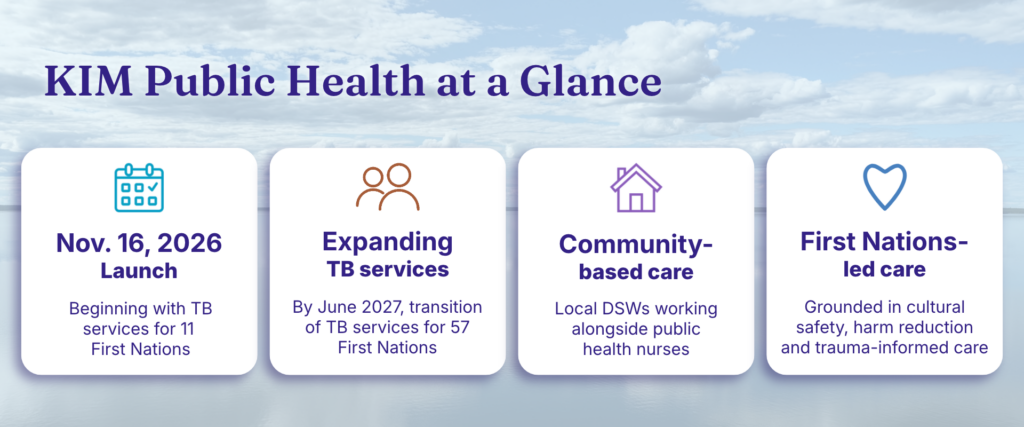
KIM is assuming responsibility for TB services for most First Nations in Manitoba, which were previously coordinated through existing provincial and federal arrangements.
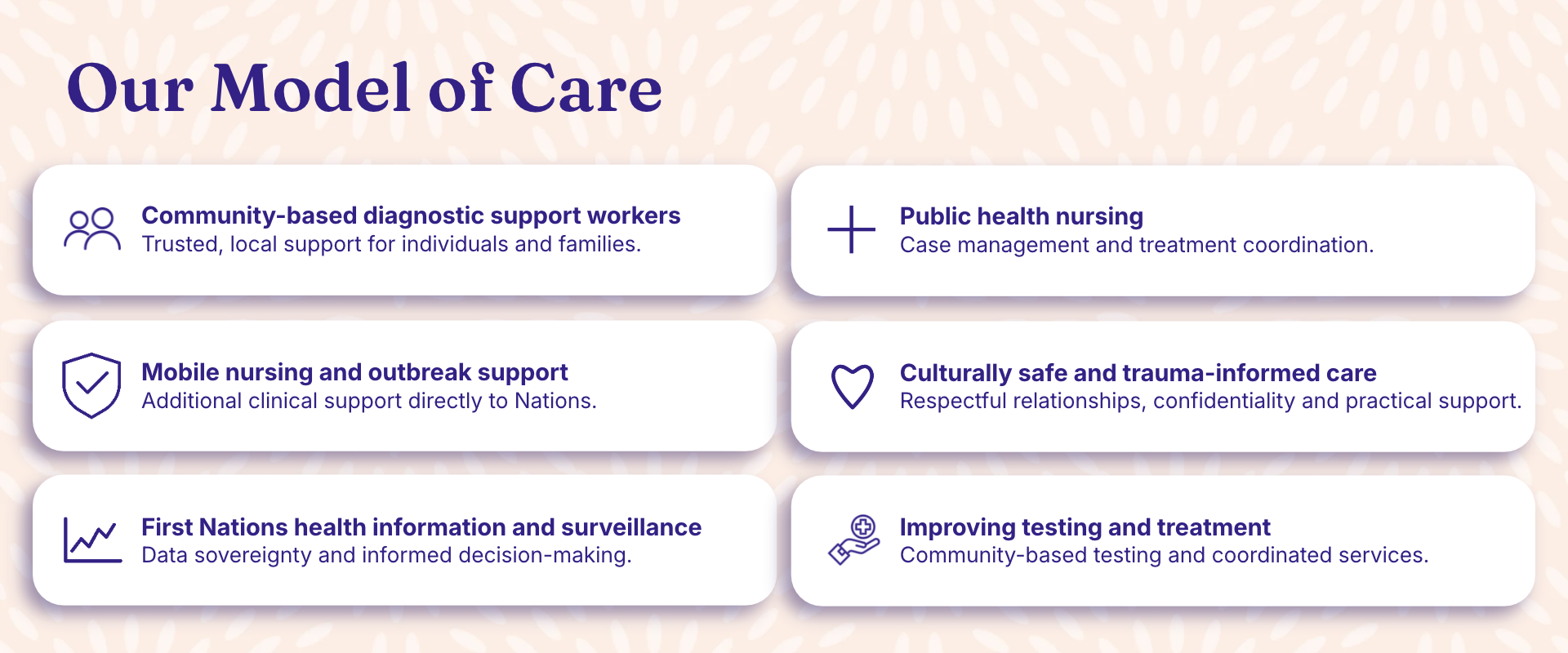
KIM is introducing a model of care that brings public health nurses together with community-based diagnostic support workers (DSWs) and other health-care professionals.
The initial focus of KIM Public Health includes:
- TB prevention, screening and testing;
- Identification and treatment of TB infection and active TB;
- TB case management and contact investigations;
- Training and supporting community-based diagnostic support workers;
- Public health nursing leadership and TB outbreak response;
- Health promotion and public health education related to TB;
- Harm reduction approaches that support disease prevention and engagement in care;
- Public health surveillance, data collection, and analysis.
Through this approach, KIM aims to reduce barriers to care, strengthen services within First Nations and develop trusted relationships with individuals, families and community health teams.
Phased Implementation
KIM is developing its Public Health Unit over a two-year period, with the transition of TB services taking place in phases through 2027.
This approach supports safe and reliable service delivery while allowing KIM to grow the First Nations health workforce, establish the necessary infrastructure and tools, and strengthen relationships with participating First Nations and health-care partners.
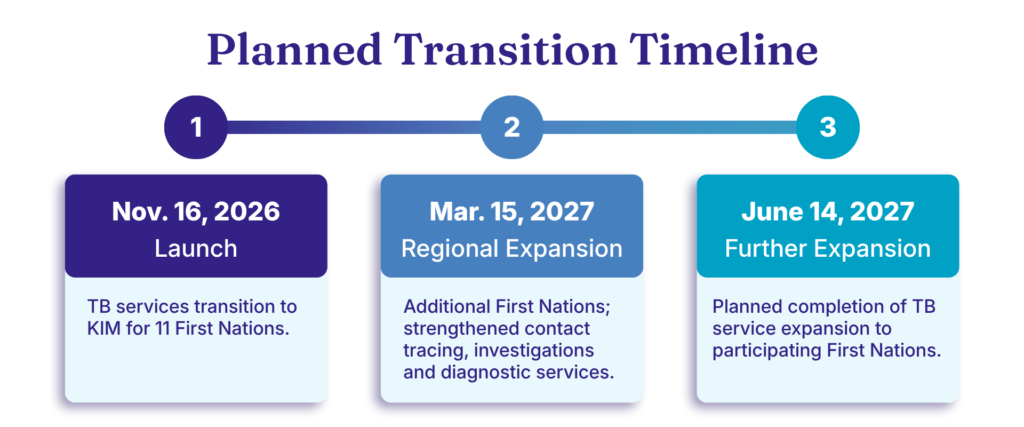
November 16, 2026 — Phase 1: Launch
KIM began assuming responsibility for TB services for 11 First Nations.
March 15, 2027 — Phase 2: Regional Expansion
TB services will expand to additional participating First Nations while KIM strengthens contact tracing, investigations, diagnostic services and its ability to deploy staff and resources where needed.
June 14, 2027 — Phase 3: Further Expansion
KIM plans to complete the expansion of TB services to participating First Nations across Manitoba.
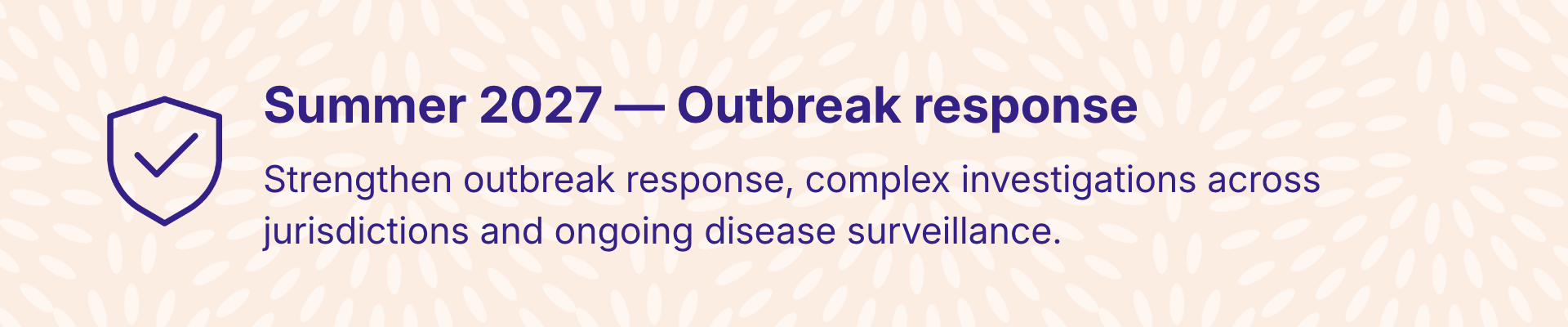
Summer 2027 — Outbreak Response
KIM will continue strengthening its ability to lead communicable disease outbreak responses, conduct complex investigations across jurisdictions and undertake ongoing disease surveillance, initially focusing on TB.
Community-Based Diagnostic Support Workers
Central to KIM’s model of care is the diagnostic support worker (DSW) role. These workers are citizens of the First Nations in which they work, bringing local knowledge, relationships, language and culture to public health service delivery.
Working alongside public health nurses, diagnostic support workers are trained to support activities such as:
- Screening and point-of-care testing;
- TB treatment support and follow-up;
- Case and contact investigations;
- Supporting individuals in accessing care, attending appointments and completing treatment;
- Health promotion and public health education;
- Other public health activities as services expand.
Investing in a local First Nations health workforce strengthens the services available within Nations and provides individuals, families and community health teams with trusted, accessible support.
To support the development of this workforce, KIM has partnered with RRC Polytech to offer the Diagnostic Support Worker Applied Certificate Program. The program combines online learning, hands-on skills training and supervised clinical experience, with opportunities to develop competencies in areas such as phlebotomy, electrocardiography (ECG) and radiographic procedures. Designed to support health-care access in remote First Nations, the program provides opportunities for participants to gain clinical skills while maintaining connections to their home Nations.
Public Health Nursing
KIM’s public health nurses provide clinical guidance, TB case management, treatment coordination, education and support to community-based diagnostic support workers.
Public health nurse leads support program development, clinical standards, procedures, workforce education and collaboration with pharmacists, physicians, specialists, clinics and other health-care providers.
This collaborative approach strengthens the connections between community-based services and the broader health-care system, supporting continuity of care for individuals and families.
Mobile Nursing and Outbreak Support
KIM’s public health model includes mobile nurses who can travel to First Nations to respond to emerging public health needs and provide additional support to community health teams.
Initially, mobile nursing services will focus on TB outbreak response, investigations and other TB-related public health needs.
As KIM Public Health grows and additional resources become available, mobile nursing services are intended to support broader communicable disease outbreak responses, immunization clinics, health promotion and public health education.
This approach allows additional health-care resources to be brought directly to First Nations when needed.
Improving Access to Testing and Treatment
KIM is working to improve access to diagnostic services and reduce delays between screening, diagnosis and treatment.
This includes exploring opportunities for point-of-care testing, virtual care, and stronger connections between community-based workers, nurses, pharmacists, physicians, and specialists.
Through these approaches, KIM aims to reduce unnecessary travel, improve continuity of care, and support individuals in receiving services closer to home whenever possible.
Culturally Safe and Trauma-Informed Care
KIM recognizes that experiences of racism, discrimination and stigma can create significant barriers to accessing health care and engaging with public health services.
Our approach is grounded in cultural safety, harm reduction, and trauma-informed care. Public health conversations can involve sensitive topics, including tuberculosis, sexually transmitted and blood-borne infections, HIV, substance use, and contact tracing.
KIM emphasizes confidentiality, respectful conversations, clear information, informed decision-making, and practical supports that respond to the needs of individuals and families.
First Nations Health Information and Surveillance
Timely and accurate public health information is essential to understanding health needs, identifying emerging concerns, monitoring disease transmission, and improving services.
KIM will use public health surveillance, data collection and analysis to better understand patterns of illness, identify service needs, evaluate health outcomes and support planning with participating First Nations.
KIM recognizes First Nations’ rights to govern information about their citizens. This work will respect First Nations data sovereignty and the privacy and confidentiality of personal health information.
The phased transition of TB services extends to 57 First Nations across Manitoba.
Phase 1 | November 16, 2026
- Berens River First Nation
- Little Grand Rapids First Nation
- Manto Sipi Cree Nation
- Northlands Denesuline First Nation
- Opaskwayak Cree Nation
- Poplar River First Nation
- Sandy Bay Ojibway First Nation
- Sapotaweyak Cree Nation
- Tataskweyak Cree Nation
- Wuskwi Sipihk First Nation
- York Factory First Nation
Phase 2 | March 15, 2027
- Bunibonibee Cree Nation
- God’s Lake First Nation
- Long Plain First Nation
- Mathias Colomb Cree Nation
- Nisichawayasihk Cree Nation
- Peguis First Nation
- Pimicikamak Cree Nation
- Sayisi Dene Denesuline First Nation
- Shamattawa First Nation
Phase 3 | June 14, 2027
- Barren Lands First Nation
- Birdtail Sioux Dakota Nation
- Black River First Nation
- Bloodvein River First Nation
- Brokenhead Ojibway Nation
- Buffalo Point First Nation
- Canupawakpa Dakota Nation
- Dakota Plains Wahpeton First Nation
- Dakota Tipi First Nation
- Dauphin River First Nation
- Ebb and Flow First Nation
- Fisher River Cree Nation
- Gambler First Nation
- Garden Hill First Nation
- Hollow Water First Nation
- Keeseekoowenin Ojibway First Nation
- Kinonjeoshtegon First Nation
- Lake Manitoba First Nation
- Lake St. Martin First Nation
- Little Saskatchewan First Nation
- Minegoziibe Anishinabe
- Norway House Cree Nation
- O-Chi-Chak-Ko-Sipi First Nation
- O-Pipon-Na-Piwin Cree Nation
- Pauingassi First Nation
- Pinaymootang First Nation
- Red Sucker Lake First Nation
- Rolling River First Nation
- Roseau River Anishinabe First Nation
- Sagkeeng Anicinabe First Nation
- Sioux Valley Dakota Nation
- Skownan First Nation
- St. Theresa Point First Nation
- Swan Lake First Nation
- Tootinaowaziibeeng Treaty Reserve
- Wasagamack First Nation
- Waywayseecappo First Nation
Information for Individuals and Families
KIM is committed to working with First Nations, health-care providers and existing service partners to support continuity of care throughout the transition.
Frequently Asked Questions
I am currently receiving TB treatment. What does this transition mean for me?
Continue taking your prescribed TB medication and attending scheduled appointments unless otherwise directed by your health-care provider. If you have questions about your treatment or the transition, contact your health-care provider or community health team.
What should I do if I think I have been exposed to TB or need TB testing?
Your point of contact for TB care remains your health centre or nursing station. Contact your local health-care provider or community health team for guidance on assessment and testing.
Will my personal health information remain confidential?
KIM recognizes the importance of privacy and confidentiality in public health service delivery. Personal health information will be handled in accordance with applicable privacy requirements.
Who can I contact for more information?
For general inquiries about KIM Public Health or the transition of TB services, contact [email protected] .